Last night I watched Hari Kondabolu’s Netflix special. His comedy is both smart and very funny. His parents emigrated from India before he was born and a lot of his comedy addresses ideas about race and culture. One of the things he talks about on stage is how some “white people” don’t like to be labeled as a racial category (“white people”). To many whites, it’s the “other” people that need descriptors—black people , Indian people, Mexican people …. White is the default, the so-called norm. But as Hari points out, the notion of race as a biological divider is a made-up thing (even though the resulting racism is very real). And even the idea of who belongs in which category has changed over the years as groups once considered NOT white (Italian, Irish, and Jewish people for example) have been welcomed into the “white race.”
He does this in a very funny way, but it’s also a great mini-history lesson on race in America. Except for the being funny part, his observations mirror the introduction lecture I gave when I taught a course called “American Diversity: Contested Visions of the American Experience.” This class examined how ideas about race (and gender) were constructed in the U.S. and how those shifting ideas affected (and continue to affect) us. As I watched (and laughed), I even thought to myself: “I should just play this special in class. They’d probably pay more attention.” Then I remembered I don’t teach anymore. So while I was laughing at Hari’s take on race issues, I also realized that I was feeling a bit discombobulated.
This feeling had begun to bubble to the surface earlier in the week when Childish Gambino’s video “This is America” premiered. Like Hari’s routines, Donald Glover’s inspired melding of history and the present immediately filled my mind with ideas about how it could be incorporated into a class. And those ideas intermingled with thoughts I had the week earlier when Kanye made his ridiculous slavery as a “choice” comments. And all of that is layered over the Trump & Team’s repeating examples of racism, xenophobia, and misogyny. My TEACHER brain is overloaded with ideas.
But, reality check. it’s been over a year since I’ve been in front of a class. And I have struggled with questions of identity and purpose since I left. If I don’t have a classroom, am I still a teacher? Do still want to be a teacher? Can I be of service outside of the classroom? Truthfully, in some ways it’s been a relief to NOT be in the classroom especially in Trump’s America. For one, I no longer have to try and censure or tone down my personal opinions. (On that front, I’m sure some of my former students would question that I even tried. I did! But I wasn’t always successful.) But at the same time, I hope that I did some good. You can’t fix something if you don’t address it. Speaking honestly and openly about race issues was often a heavy weight, especially as a middle-age white woman. But I think I got better every year at navigating the responsibility. I think I may have done some good.
For some students (both students of color and “white” students), it was the first time that they explored how the category of race was built in America. Many had never been exposed to the reality that the label is not an unchanging “natural” one. As Hari points out in his show, it has shifted and changed over time. Those with the power endeavored to make “race” do (or mean) what they wanted while those subjected to the negative effects of this effort resisted and acted to try and shape their experience. Understanding the depth and breadth of both its construction and the simultaneous resistance can be both exhausting and empowering. Being a part of that uncovering—for lack of a better term—was fulfilling.
But, should exposing the roots of racial construction and how it continues to affect our world today be about my fulfillment? Is thinking that my voice is needed part of the problem? As a white woman, is stepping away from the front actually the responsible thing? I don’t want to be part of the “white feminism” problem. I don’t want to speak over the voices that have lived experience. (I don’t want to be associated with the “women’s edit” of “This is America.” Not everything is about white women!!) But I also know that sometimes white ears only hear white voices. So I’m thinking and reading and educating myself. And wondering, is being an ally and a supportive (not leading) voice for things I believe in the answer? How do I best do good? And, if I’m being honest, I also wonder what can I do to FEEL like I’m doing good?
So I guess all my questions come down to one: How can I do good, and feel good, from the back? How can I “flip the classroom” if I don’t have a class?!
I haven’t completely figured that out yet, but I’m working on it.

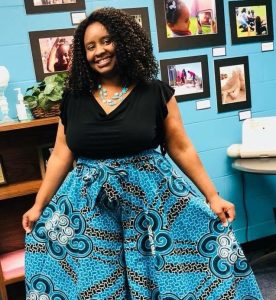
 Tina Stewart Brakebill